Showing posts with label career guidance. Show all posts

Monday, 16 March 2026

The Myth of Futureproofing ANYTHING

The term Future proof is being used a lot over the past few years, and continues today.  You find it in advertisements for a number of products, like learning (Future Proof Your Job), career (enroll for this course to future proof your career), family and relationships (buy this product to future proof this relationship). Given my reading and experience, I wondered if any form of future-proofing would be possible in reality.  Here are some definitions of the term "future proof" that I checked from the net to see if my understanding matched (it did).

Future proof is a term used to describe a product, service, or business that is designed or structured to withstand the challenges of the future. www.bluestonepim.com

to design software, a computer, etc. so that it can still be used in the future, even when technology changes - Cambridge Dictionary

If you future-proof something, you design or change it so that it will continue to be useful or successful in the future if the situation changes - Collins Dictionary

As you can see, the definitions talk about the ability of something to stay relevant and useful even when surrounding circumstances change in the future.  

pexels-thisisengineering-3913025


The reality is that knowing what is in the future is one thing, but knowing what the future means is an entirely different matter.

Considering that the number of events that have occurred in the world over the past 8 years (like the lockdowns) were mostly unpredictable, the results of those events could not have been visualized or understood immediately.  What we know is that very little of what we have known for sure in the past has remain unchanged.  Even without the explosion of AI tools, the requirement for people to adapt has greatly increased in the past 30 years.  

The impact of AI tools is still taking place, in ways we haven't understood or imagined yet - for eg. the impact of AI systems on the planet's environment is not talked about as much as it could be.  The current war in the middle east and other domestic and international policies provide zero indication of things stabilizing, and while adaptability is once more a key skill for humans,  in reality, what are the chances of really futureproofing anything?

What can you do?

  • Develop awareness of yourself i.e. strengths, weaknesses, and so on.  I've given more details in this video here - https://youtu.be/9etu02AtSJA. 
  • Upgrade yourself. Keep learning things that you could possibly turn into a career and make money.
  • Study trends - political and market. Review the recent past, keep an eye on current trends and attempt to discern which way the wind seems to be blowing.
  • Get a mentor or coach - It always helps to have someone to talk to about such things.  If there's someone in the family who you trust and look up to for advice, then please do that, or else put aside funds to engage a professional (like me).
  • Build your network - become known in the industry you work or want to work.  Essentially, it means be polite to everyone you meet, without evaluating how someone may be able to help you.
  • Do your own due diligence - Beware of tall claims, should you wish to opt for one of the offers of future proofing, and take the time to understand what contingencies they have planned for, what costs are involved, including time (you definitely can't get your time back), do reference checks on your own, be clear about the benefits that are being promised.  Some of these offers may actually suit your needs, especially if they're being open and honest with you.

Finally - don't believe all the ads you see about future proofing your job, career, business, industry.  Nobody really knows the future either. 


Monday, 23 October 2023

When Your Calling Doesn’t Call: What Do You Do Without a Life Passion?

Interesting headline? Read on... 


“If we don’t know what we want to be when we grow up, is there something fundamentally wrong with us?”

Following our joy, chasing our bliss, finding our dharma: these are good things, right? We want to be like the heroic people who gave up the security of some well-paying 9-to-5 in order to move to Greece and start a goat farm that can power a small village. Amazing, right? Let’s all follow our passions!

But what if we don’t have one? What if there’s nothing in particular we’d want to give up our steady paycheck for? What if we care about living a meaningful life but don’t know what, exactly, that would look like?

If you feel this way, you’re not alone. The people that turned their passions into lucrative careers are happy to toot their own horns about it, and loudly. But most of us aren’t doing that. We haven’t found our calling, so we keep waiting for the phone to ring. We join the circus or buy a mobile home to sell our jewelry out of, and for a while, it feels like a life calling. It feels meaningful and important. Then, after a while, exhausted from working too hard and making too little, we realize that we’re bored and frustrated and maybe we’re not in love with what we thought was our calling anymore. Turns out the call was just spam.

Then we start to wonder: If we don’t know what we want to be when we grow up, is there something fundamentally wrong with us?

There isn’t. It’s a myth that we all have some single grand life passion that we must be following or we’re living some pale, flaccid version of life. It’s as mythological as the idea of The One for romantic love.

Read the rest of this fascinating article here.

While you do that, I advocate that you should identify a Purpose that aligns with your strengths. This purpose is not written in stone - meaning, you can change it whenever you like, or even have more than one Purpose at a time. I support my Strengths-based career coaching clients in this journey.

If you want to know how to do this, contact me on +919820155778 or write to ryanbbarretto@hotmail.com for a discussion.

Friday, 17 February 2023

Participant Feedback - Design Your Life for Take Charge Mentees

I had a wonderful time designing and running this session for the mentees of Take Charge 5 i.e. Fifth Batch.  The participants comprised of those on the cusp of graduation, as well as those who were already employed in some capacity.

They went through various exercises focused on enabling them to think about how they want to build their future, understand the values that drive them, consider the personal brand that they want to build for themselves, take steps to understand their strengths and to navigate the helpfully harmful advice that will come their way.

Here are some pictures of what happened.


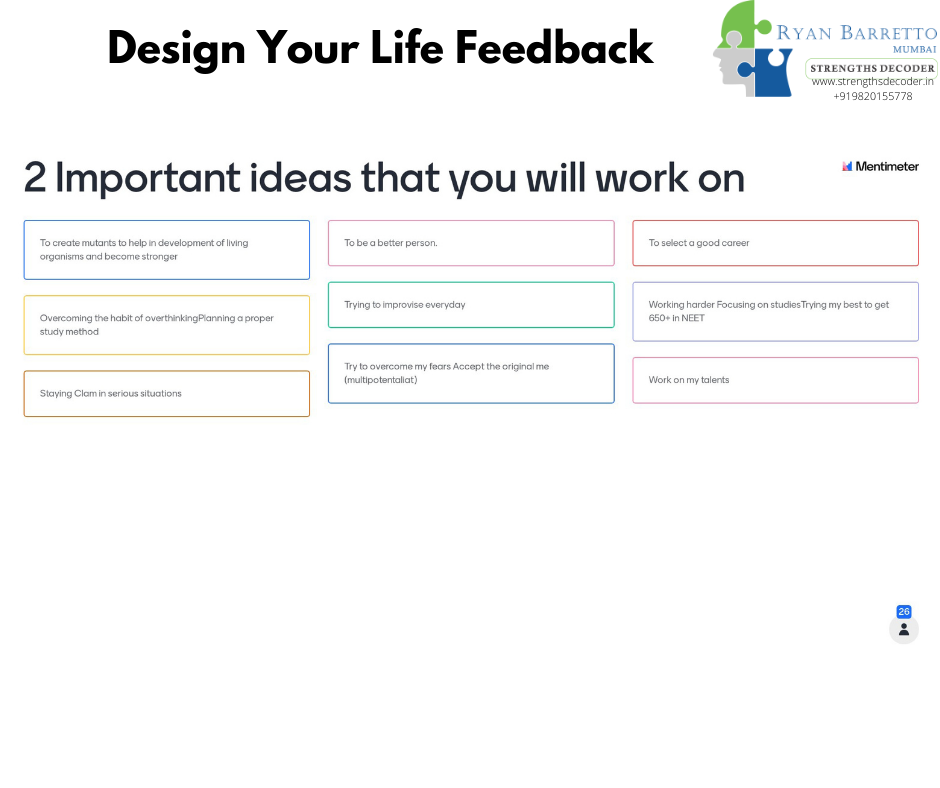
And here's some of the things that stayed with them by the end of the day.


Thanks to the people at Take Charge (Cheryl / Andre / Jessica) for giving me the opportunity to contribute my knowledge and experience.  


Sunday, 12 June 2022

How Strengths can combat the Imposter Syndrome

Pic credit: pexels-beatrice-pioquinto-11762783

The term 'Imposter Syndrome' has gained prominence over the past decade.  Here's a google definition of what it means:

"Imposter syndrome is loosely defined as doubting your abilities and feeling like a fraud. It disproportionately affects high-achieving people, who find it difficult to accept their accomplishments. Many question whether they're deserving of accolades."

This tends to manifest as an internal voice (that can grow in volume) that questions everything you do or are thinking of doing. Think of it as your personal Devil's Advocate that no one but you can hear.  It initially seems like the voice of caution. As time goes by, it becomes more nagging and persistent.  It is a great recorder of past failures and loves surfacing those memories especially when we make plans for a new future.  You might even have the song "The Great Pretender" playing as your soundtrack in the background

Here's the main problem - it distracts us from doing our best work.  It scares us when we want to take a risk.  It fills our head with thoughts of failures, being abandoned by those close to us and maintaining the status quo, thus stunting our growth.  "Who do you think you are to attempt this?", it asks us constantly.

The bad news - we can't get rid of it.  Eons of evolution have allowed us to develop cautious thinking and behaviour to a fine art till we reach a stage where many of us allow it to control every aspect of what we do.

The good news - we don't need to get rid of it because it is also quite useful.  It helps us identify and plan for potential potholes in our road ahead.  So we need to manage it by being more thorough in our research and experimentation.

In my experience and understanding, the impostor syndrome exists because of 2 reasons:

1) Our need to get things right.

2) Our fear of getting things wrong.


Both these two boil down to "What will people say?"


The complete sentence that is rarely articulated is "What will people say about us, and the result, when they see the result?". The result is that we don't take steps forward, but remain stuck, give up on our dreams and then have plenty of regrets - "What if I had tried ______?". I've seen this many times as an interviewer and as a career coach. Please note-We must be aware that these thoughts trigger feelings and emotions in the human brain that are similar to situations when we are being physically attacked. The brain can't distinguish between real attacks and perceived attacks and applies the same strategy to defend the body. The net result is that your cognitive (thinking and reasoning) abilities are reduced because blood for these areas of the brain is diverted to other organs to prepare a fight or flight response.


This behaviour related to the above two reasons is called "resulting", a term which I picked up from the superb book 'Thinking in Bets' by Annie Duke. This term refers to the time and energy we spend on deciding that is so focused on the outcome, that we don't take action or don't take appropriate action soon enough. This affects the quality of our decision and thus, our outcomes / results. It means we haven't yet developed a robust decision-making process.


Before we take decisions, and act on those decisions, the most critical thing we can do to combat Imposter Syndrome is to Know Ourselves. Without knowing yourself, you will have no idea what to do when disruption happens. You are likely to end up with a feeling of disconnection, discontent and confusion, and are likely to miss growth opportunities.


But this is a common phrase - "know yourself". It is also woefully short on actual direction or action points. Here's my thoughts about "Knowing Yourself" based on my own introspection, experiences and research:

  1. Know Your Strengths (what you are really good at doing / delivering great value)
  2. Know your Weaknesses (the tasks or activities that frustrate you or make you downright miserable with or without value being delivered)
  3. Your Preferences (What strengths do you prefer using?)
  4. Your Biases (What triggers you? This refers to external environment factors particularly other peoples' behaviour / actions that cause discomfort for you)


As you look at this list, you may realize that while you may have some awareness of the first two points, and as they are discussed a lot in the Self-development Learning space, there is generally little or no discussion on the other two points. Those are the areas that aid or trip us more than the awareness or lack thereof of our strengths and weaknesses.


What do these areas have to do with Imposter Syndrome?

  • They're all reminders of who you are, and who you are NOT - as a person.
  • They help you remember that you don't have much control on what happens in the outside world. This is where being aware of your biases helps tremendously. eg. I have a challenge with working with people who don't want to think on their own and expect to get spoon fed all the time. This can cause me to get angry, sarcastic and so on. To avoid my reactions, I have to carefully choose who I want to work with.
  • Your strengths particularly will remind you of what you are good at and what will give you joy.
  • Your weaknesses will remind you it is ok to not be good at some things and so indicate which areas you can do your best to avoid.


Keep in mind that you are developing awareness in these four areas, and it is an ongoing lifelong process.


Now you are in a better position to combat this internal voice called Imposter Syndrome. Why? Because after this exercise of Self Awareness, you can now Strategically Apply Your Strengths to do what needs to be done to achieve your goals. You will be in a better position to shut out or pay attention to the voice, take that risk, and focus particular strengths that can suit the situation to leverage your success. You can move from thinking "All this can go wrong" to thoughts that say "These are my options based on my capabilities".


Most importantly, you are gaining freedom from "what people will say", there is more confidence in your actions that is grounded in your self-knowledge, particularly your strengths.


How to develop this awareness?

Option A

  1. Take feedback from trusted sources (this means that they're comfortable giving you bad news), and don't comment or justify your point of view. Simply make a note of what they offer.
  2. Create action plans with the help of a Strengths Strategy Coach.

Option B

  1. Take the PRISM Professional Brainmapping Inventory to understand your Behaviour Preferences, strengths and weaknesses.
  2. Follow this with coaching to become aware of your biases.

Of course, this means a lot of practice, but with sufficient focus, you will be in a better position to manage the imposter and work towards your success.


Doing this regularly means that over time, you'll find the voice of the Imposter going softer and softer, as you climb from success to success.


To know about PRISM Brainmapping Inventory, visit www.prismbrainmapping,com and connect with a certified practitioner, i.e. me, on +919820155778 to know more.


Sunday, 29 May 2022

Feedback - Design Your Life Workshop

I had the pleasure of conducting a workshop entitled "Design Your Life" recently for 30 young participants of St. Blaise Church,  Amboli.  They were initially shy and then warmed up to ask interesting questions and make the workshop more engaging.  Interestingly, we had a few parents who also attended too, and that added an interesting dimension to the discussions.

We covered aspects of planning one's career and life (both are intertwined anyway). 

I shared with them tools such as a Personal Values Exercise, a Personal Brand Exercise, How to identify where they may have talents, how to build flow, how to identify areas of success to work on, and a few more reflective exercises, that would help them make better decisions for their career.  I also spoke about the #PRISM Brainmapping Career Match Report that is great in helping people identify possible career paths. Please call me onn +919820155778 or write to me on ryanbbarretto@hotmail.com to know more about this neuroscience-based tool..

My sincere thanks to Fr. Leon and the volunteers who provided all the necessary support.  Here are some images that depict what the participants are going to work on, and a wordcloud that shows what they felt after attending the session (the range of feelings was expected, as it demonstrates to me that they started to think about designing their careers).


Tuesday, 29 March 2022

Do you need a career coach?

Here's an article that talks about my coaching niche - #careers. Specifically, how do you know that you need a career coach.

Not all accomplishments, no matter how great, belong on a resume. 

This is a line from the article that I have to regularly remind my clients


Read on here - and write to me if you find something in the article that resonates with you, or if you just have questions.


coaching